TÖRNER

Mon–Fri 8:00–17:00

Wishlist Count 0
Model series

Mazak VCN – used machines, fully inspected

The Mazak VCN is Yamazaki Mazak’s line of vertical machining centers. The table travels in X and Y, the spindle head in Z, and the spindle takes No. 40 or HSK-A63 tooling. The line runs from the compact VCN-430A with a 900 × 430 mm table to the VCN-700 with 1,500 × 700 mm. That covers classic milling work on plates, housings and mold components.

The list below shows which VCN machines are currently for sale. Every machine is inspected and documented by our own technicians. Transport and commissioning come from a single source.

3

Machines available

Current stock

Which Mazak VCN are currently available?
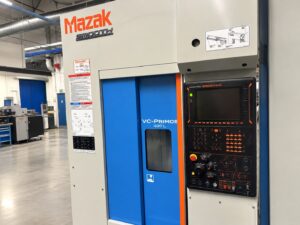
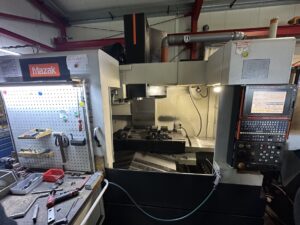
Mazak-VCP-400L-1
Mazak
REF: 24190
Year 2021Control Smooth C
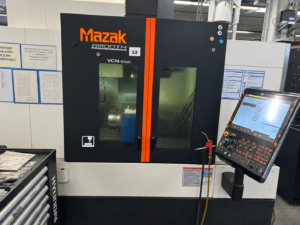
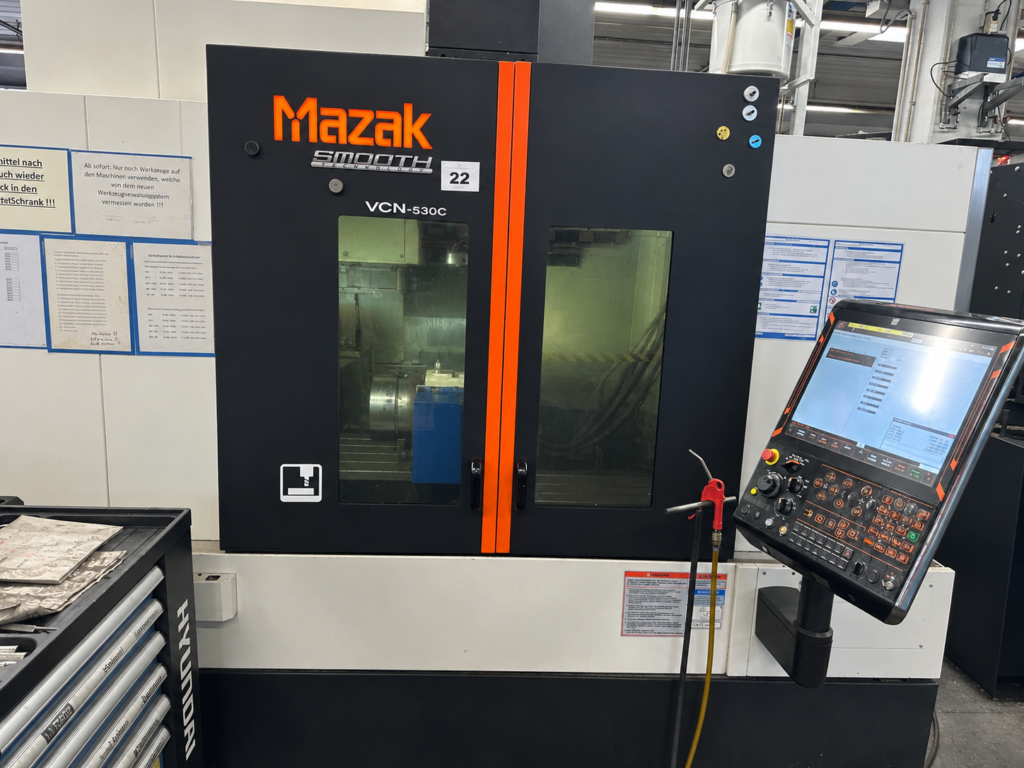
Mazak-vcn-530-c-vertical-center (2)
Mazak
REF: 24185
Year 2020Control Smooth G
Mazak-VCN-510-C-II-gebraucht-kaufen
Mazak
REF: 24174
Year 2010Control Matrix

No suitable Mazak VCN listed? Tell us what you are looking for – we will contact you as soon as a matching machine is available.

Brochures & data sheets

Technical documents for the Mazak VCN series

Manufacturer documents by Mazak. For a specific used machine, its own data sheet applies.
Why TÖRNER

What you get when you buy a VCN from us

Every machine is fully inspected and documented by our own technicians before it is sold. Purchase, shipping, installation, commissioning, maintenance and financing are then all handled by a single partner.

We buy your Mazak VCN

We buy your used Mazak VCN fairly and quickly.

Maintenance & repair

Certified technicians for Fanuc controls and Mazak-specific components.

Transport & commissioning

Professional dismantling, transport and commissioning including customer training.

Financing & leasing

Flexible financing options for your Mazak machine purchase — including hire purchase.

Mazak VCN machine request

Looking for a specific model of the series? We'll find it for you.

About the series

The VCN Series Explained

Mazak-vcn-530-c-vertical-center (2)
Vertical machining center

Machine type

Yamazaki Mazak, Japan

Manufacturer

MAZATROL 640M to SmoothG

MAZATROL control generations

X-Y table, Z spindle head, 4th axis optional

Kinematics

10

Machines sold

What sets the VCN apart from a basic vertical machining center?

The VCN is Mazak’s workhorse among vertical machining centers: a C-frame column, the table moving in X and Y, the spindle head in Z. For the current generation Mazak quotes ball screws with core cooling and a thermal compensation system (Thermal Shield). Rapid traverse is 42 m/min on all three axes.

The spindle is matched to the machine size. On the VCN-430A and VCN-530C, 12,000 rpm with 18.5 kW (5-minute rating) is standard. On the VCN-500, VCN-600 and VCN-700 it is 15,000 rpm with 22 kW; as an option Mazak lists an 18,000 rpm spindle with 30 kW and 120 Nm.

The tool magazine holds 30 tools as standard; for the VCN-430A and VCN-530C the brochure lists 40 tools as an option. The spindle taper is No. 40 (CAT/BT 40) or HSK-A63.

Which sizes exist, and what do 430A, 530C, 700 and HS mean?

The number in the model name stands for the machine size, the letter after it for the build level within that size. HS marks the version with the high-speed spindle, for which Mazak quotes 18,000 rpm. Table sizes and X travels according to Mazak are in the table further down this page.

Older machines of the same line carry the name VC NEXUS, for example VC NEXUS 410A-II or 510C-II. That is not a different series but the generation with MAZATROL Matrix from around 2006 to 2010.

  • VCN-430A / VCN-530C — compact sizes with a 12,000 rpm spindle, available as HS versions with 18,000 rpm
  • VCN-500 / VCN-600 / VCN-700 — the larger tables up to 1,500 × 700 mm with a 15,000 rpm spindle
  • VC NEXUS 410A / 510C — previous generation with Matrix control, common on the used market

Which Mazatrol generation is installed, and what does that mean?

When buying used, the control decides over usability and the programming environment. All generations handle EIA/ISO G-code from CAM in addition to Mazatrol conversational programming.

Matching control to build year is only a guide: overlaps and different fit-outs occur. The control actually installed is stated in the data sheet of the specific machine.

  • MAZATROL 640M — early VCN and VC NEXUS machines, build years around 2006
  • MAZATROL Matrix — VC NEXUS II generation, roughly 2006 to 2010
  • SmoothG — current VCN-430A, 530C, 500, 600 and 700 with touch-screen operation
  • SmoothEz — entry-level control of the sister VCE series
  • SmoothC — compact VC PRIMOS

VCN, VCE or VC PRIMOS: which line suits which production?

The VCN is the main line with SmoothG, a 30-tool magazine and 42 m/min rapids. It fits when you machine steel and cast iron as well as aluminum and need tables from 900 to 1,500 mm.

The VCE is Mazak’s entry-level line with SmoothEz: 12,000 rpm and 18.5 kW, 36 m/min rapids, a magazine with 30 or 48 tools. Tables measure 1,050 × 500 and 1,300 × 600 mm. It pays off when price matters more than the last few percent of dynamics.

The VC PRIMOS 400L is the compact machine for small parts in high volumes. Mazak quotes a BT-30 spindle (BBT30 or HSK-A50 optional), 12,000 rpm as standard and 20,000 rpm as an option, 14 tool pockets (19 or 21 optional) and 60 m/min rapids.

Model variants

Which size suits your workpiece?

The choice depends less on the model number than on five points. These are table size and travels, spindle speed and tool taper, magazine capacity, fourth axis and control generation. Machine size rises with the number — Mazak quotes the following tables:

SizeTable size according to MazakX travel
VCN-430A900 × 430 mm560 mm
VCN-5001,050 × 500 mm800 mm
VCN-530C1,300 × 550 mm1,050 mm
VCN-6001,300 × 600 mm1,050 mm
VCN-7001,500 × 700 mm1,300 mm

Over the years VCN machines from every generation have passed through our hands: VC NEXUS 410A and 510C with Matrix, VCN 510 HS with 640M, VCN-430A and VCN-530C with SmoothG, plus the VC PRIMOS. The concrete figures for every available machine are in the list above and on the machine page.

FAQ

Frequently asked questions about the Mazak VCN

What condition are the used VCN machines in, and how is that checked?

Every machine is inspected and documented by our own technicians before sale. We check the spindle, guideways and ball screws, tool changer and control. Added to that are the operating hours, where they can be read out, and the accessories and tooling included. On a VCN, the spindle bearings and the tool changer deserve a close look. Both work hardest in continuous operation. An inspection under power can be arranged.

What warranty applies when buying a used machine?

We sell business to business. The scope of liability for defects is expressly defined in the purchase contract, so you see it before signing rather than after delivery. In advance you receive the condition report and the inspection documentation, with an inspection under power on request. Which commitments on function at handover, commissioning and rework are possible, we clarify for each machine. Raise it with us before ordering so that it is stated in writing in the quotation.

Which Mazatrol control is installed, and what does that mean for programming?

That depends on the build year: early VCN and VC NEXUS machines run MAZATROL 640M, the NEXUS II generation Matrix, the current VCN-430A, 530C, 500, 600 and 700 SmoothG. All handle Mazatrol conversational programming and EIA/ISO. Which control and software level are actually installed, we check for each machine and state in the quotation.

Is the VCN available with a fourth axis or a pallet changer?

Mazak quotes simultaneous control of up to four axes for the VCN; an NC rotary table as fourth axis is an option. For some sizes the manufacturer's brochure also lists a two-pallet changer. Whether a specific used machine is equipped that way is in its data sheet — we state it in the quotation.

What does a used Mazak VCN cost?

There is no list price on the used market. The price is set by build year, control generation, operating hours, the condition of spindle and guideways, and the equipment — a fourth axis, magazine capacity and a touch probe make a clear difference. We quote the price on request, in writing and with the data sheet, so you can compare it.

What if no suitable VCN is in stock right now?

Then we take a machine request: size, control generation, desired equipment and build-year window. As soon as a suitable VCN becomes available, we get back to you with data sheet and photos — from our own stock or through our worldwide network.

How buying works

Five steps to the right Mazak VCN

  1. 1
    Enquiry

    Call or form: workpiece, material and the equipment you need are enough to start.

  2. 2
    Data sheet and photos

    You receive data sheet, photos and condition report of the matching machines in stock.

  3. 3
    Inspection

    By arrangement you see the machine under power, at our site or at the previous owner.

  4. 4
    Quotation

    Price, scope of liability for defects and delivery time are stated in writing in the quotation.

  5. 5
    Transport and commissioning

    Dismantling, transport, installation and commissioning with training come from a single source.

No suitable Mazak VCN listed? Tell us what you are looking for – we will contact you as soon as a matching machine is available.

Other model series

We also trade these Mazak series — and any other on request.

Find the Right VCN

Call us or send us a short description of your workpiece via the form. Dimensions, material and whether you need a fourth axis are enough to start. Everything else — table size, tool pockets and the Mazatrol generation you are used to — we clarify by phone.

You receive the data sheet, photos and condition report of the matching machines from our stock. If the model you are looking for is not available right now, we start a machine request through our worldwide network.

TÖRNER is an independent dealer in used machine tools and has no business affiliation with Yamazaki Mazak Corporation. Mazak, VCN and MAZATROL are trademarks of Yamazaki Mazak Corporation and are used here solely to describe the machines offered.